Biking

"In the field" railroad history adventures...

Thursday, December 26, 2024

Exploring Tariffville RR Remnants

 On a whim I decided to get back into exploring abandoned railroads and headed up to Tariffville, CT. I've mountain biked nearby at Cowles Park and knew it was a scenic area.

1893 Topo Maps

At the start of what is known as the Tariffvlle Gorge,  I discovered the remnants of an abandoned road bridge.


I then stopped in at the Cracker Barrel Pub and had a wonderful sandwich and beer. The pub even had some local railroad photos!

Further down the street was the entrance to the town park where you can see the remnants of the old RR bridge. The maps below show the abandoned route of that line that went up to Springfield, MA

The piers are still standing!
The view from across the river:

I drove southwesterly hoping to check out the other bridge across the river but any access to that stretch of the river was blocked by swanky homes and private property.


I proceeded on to the Hoskins section of Simsbury and did manage to find where the ROW joined the New Haven line.

Curiosity got the best of me so I decided to head home via Mountain Road in Tariffville only to  discover it dead ended and a section has been set aside as a trail!
So I drove back and drove to the other side of it. It looks like a great place to hike so I'll be back at some point for sure.
Lastly, I stopped by the bike trail which apparently was the old ROW of the Connecticut Western Railroad. Gonna have to ride this in the spring!

Heading home I stopped by the end of the former Connecticut Western Railroad that still is active. It is known as the Griffin Spur as there are a lot of industrial warehouses and distribution centers just south in Bloomfield.

The Connecticut Western Railroad

The Connecticut Western Railroad was chartered June 25, 1868 to run from Hartford, Connecticut, west to the New York state line, where it would meet the Dutchess & Columbia Railroad just east of Millerton, New York. The line was completed December 21, 1871; the previous month the company had leased the easternmost section of the D&C to gain access to the New York & Harlem Railroad at Millerton. The only branch was a short one in Connecticut, south into Collinsville, which would not be completed until December, 1874. The Connecticut Western became bankrupt on April 27, 1880, (no doubt in part due to the train wreck mentioned below)and on March 31, 1881 it was reorganized as the Hartford & Connecticut Western Railroad.

Over a period of time a large number of railroads east of the Hudson and in northwestern Connecticut were incorporated together with the formation of the Central New England Railway (CNE) in 1899.

Tariffville Train Wreck

Did you know that one of  the deadliest train crashes in CT history happened in Tariffville? On January 15, 1878, around 10:00 PM, a passenger train returning from Hartford crossed the wooden bridge spanning the Farmington River at Tariffville. Suddenly one of the bridge spans collapsed, dropping two locomotives, one baggage car and three passenger coaches into the icy river. The wreck claimed 13 lives and injured more than 70, some severely. 

The great Tariffville Train Wreck, January 14, 1878
Thomas J. Dodd Research Center, University of Connecticut Libraries

Central New England Railway: 1899-1927

The original Connecticut Western had from the start been interested in building a branch from Tariffville, Connecticut, to Springfield, Massachusetts and the CNE finally began it in 1899. 

The branch opened on September 12, 1902 and passenger trains began to run on March 9, 1903. Although the New York, New Haven & Hartford Railroad (NH) acquired financial control of CNE that same year, CNE was allowed to continue to operate separately.  Source

Thursday, June 27, 2024

Former Narragansett Pier Railroad

Today while in Narragansett since it was a little windy for the beach, I decided to ride the rail tail nearby. The William C. 0' Neill Bike Path follows the path of the old Narragansett Pier Railroad up to Kingstown. Its about an hour ride (one way) and very pleasant (especially for a RR history buff like myself!).

At the start

Along the way
Wakefield Train Station
Historical Photo
Wakefield Train Station
PeaceDale Trail Station
1909 Historical Postcard
PeaceDale Trail Station

The Swamps
Arriving at the Kingston Train Station

1899 Historical Map

Tuesday, May 7, 2024

Closing the Gap

On the way to visit my Mother, I stopped for a short road bike ride on the last section of the Albany-Hudson Electric Trail that I never rode.

I started at North Chatham and rode to Nassau Lake. I was a nice day and a pleasant ride.

Nassau Village
Nassau Lake 
I turned around here
Hi-rez 
- Click to read historical info -
Back at North Chatham
Looking North

Super Short one-handed video


Friday, August 25, 2023

Wallkill Valley Rail Trail

After my wet ride on the Ashokan Rail Trail yesterday--today I traveled over to Rosendale and rode a bit of the Wallkill Valley Rail Trail. A 150 foot tall trestle, huge abandoned kiln ruins and a myriad of mining caves made it an interesting morning!

The Rosendale Trestle

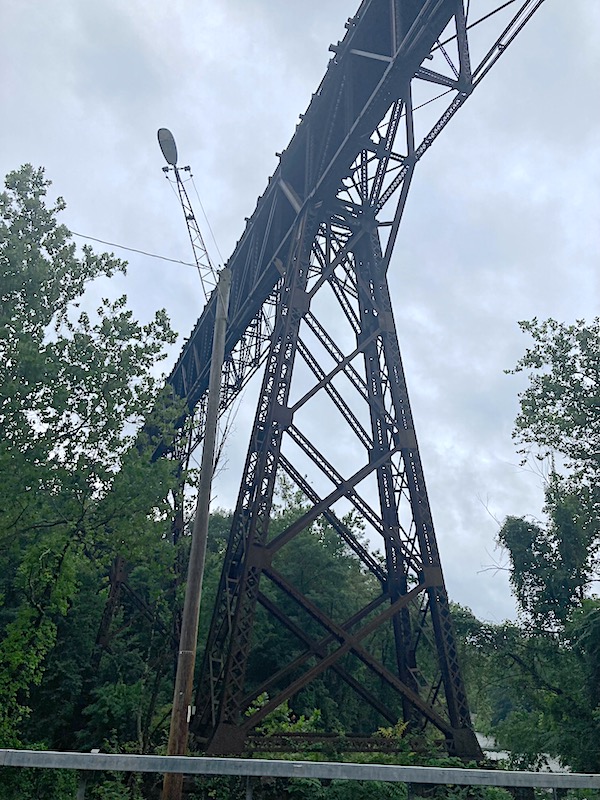
Before riding the trail, I drove underneath it!


Parking Lot - Cement Kilns

You park at the site of former cement kilns - wow - this was cool!

The Bike Ride

At the "ColdSpot"
The video is a good quick summary of the ride.
Note: I did ride my bike across the trestle but decided NOT to do a one-handed video. The trestle was wet and I'd rather not be one-handed with a camera in front of my eyes... I simply stopped to take the photos.
\
Here's where I turned around...

On the way back...

I veered off the trail to ride by these granite cliffs - glad I was riding the mountain bike!
 
Ah... another rock cut!

Back Over the Trestle

The way back was just as fun!

Riding by the Kilns

The final circle back to the car :-)

The Rosendale Cement Industry 

Rosendale cement is a natural cement that was produced in and around Rosendale, New York, beginning in 1825. More than half of the 35 million tons of natural cement produced in the United States originated with cement rock mined in Ulster County, New York, in and around the Town of Rosendale.

The limestone deposits that were discovered in Rosendale were huge, being 22 feet deep, three miles wide and extending over seven miles towards Kingston. Eventually, there were 15 giant cement mills in the area producing millions of barrels of cement a year.

Rosendale cement was used in the construction of many of the United States' most important landmarks, including the Brooklyn Bridge, the pedestal of the Statue of Liberty, Federal Hall National Memorial, and the west wing of the United States Capitol building.

The Process

Producing Natural Rosendale cement begins with the calcination of crushed dolomite in large brick kilns, fired initially by wood and then by coal. The resulting clinker is ground into progressively smaller particles. Unlike Portland cement, Rosendale cement does not require mixing of chemical additives. Historically, this natural cement product was packaged in paper-lined wooden barrels weighing 300 lbs, or in heavy canvas bags.

Bn 1871, Portland cement technology finally came to the United States. By 1900, the Hudson Valley also had two operating Portland plants. Portland cement set very rapidly and was soon preferred over Rosendale cement for mortar. By  the 20th century, the demand for Rosendale natural cement dropped precipitously, while Portland cement rapidly became the most popular building material.